
Epiphany Meaning: 8 Facts, Holiday Origins & Everyday Use 2026
Say “epiphany” to one person and they’ll picture a sudden burst of personal clarity — “I had an epiphany about my career.” Say it to another and they’ll think of a Christian holiday in early January involving three wise men.

Both are completely correct, and there’s a genuinely interesting, documented story connecting the two. This guide covers what epiphany means in both senses, plus the specific literary moment that bridged them.
See Also: NPC Meaning
Quick Answer
Epiphany means a sudden, striking realization or moment of insight — as in “she had an epiphany about what she really wanted.” Capitalized, Epiphany also refers to a Christian holiday celebrated on January 6,
commemorating the manifestation of Christ to the Magi (in Western Christianity) or Christ’s baptism (in Eastern Christianity). Both senses come from the Greek epiphaneia, meaning “appearance” or “manifestation.”

Epiphany as a Sudden Realization
In everyday, non-religious use, an epiphany is a sudden, often unexpected moment of clarity or understanding — a realization that shifts how someone sees a situation, a relationship, or themselves. It’s typically described as striking suddenly rather than arriving through slow,
deliberate reasoning: remembering where you left your keys after searching for twenty minutes, or abruptly realizing you’re in love with someone, both fit this everyday sense of the word.
This usage carries real emotional and psychological weight — an epiphany usually implies a meaningful shift in understanding, not just a minor realization.
Epiphany as a Christian Holiday
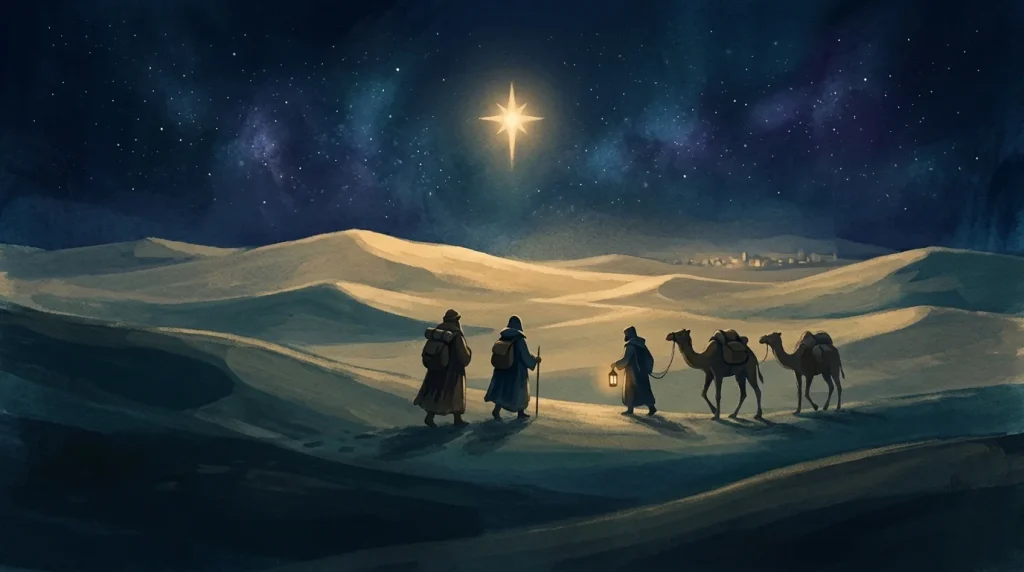
Capitalized, Epiphany refers to a Christian feast day celebrated on January 6, twelve days after Christmas. In Western Christianity, it commemorates the visit of the Magi (the Three Wise Men) to the infant Jesus, marking Christ’s manifestation to the Gentiles —
a way of showing that his significance extended beyond Israel to all nations. In Eastern Christianity, the holiday instead commemorates Jesus’s baptism, understood as the moment his identity as both fully human and fully divine was revealed to the world; there, it’s more commonly called Theophany.
Early Church leaders established Epiphany as a holiday in the second and third centuries, originally as a combined celebration covering Christ’s birth, baptism, the Magi’s visit, and his first miracle at Cana — before Christmas became its own separate holiday by the early fourth century.
Depending on the region, Epiphany is also known as Three Kings’ Day, and traditions vary widely: parades and gift-giving in Spain and Latin America, chalk blessings marked on doorways in some traditions, and ritual baptisms in icy rivers among Russian Orthodox believers.
The Bridge Between the Two Meanings: James Joyce
Here’s the detail that connects both senses, and that most explanations of either meaning skip entirely: the modern, secular “sudden realization” sense didn’t develop naturally on its own — it was deliberately borrowed and repurposed from the religious term by the writer James Joyce.
In an early manuscript called Stephen Hero (written 1904–1906, an early version of A Portrait of the Artist as a Young Man), Joyce’s character Stephen defines epiphany as “a sudden spiritual manifestation, whether in the vulgarity of speech or of gesture or in a memorable phase of the mind itself.”
Joyce took the specifically Christian, religious term and applied it to ordinary, secular moments — an object, a gesture, an overheard phrase suddenly revealing its deeper significance to an observer, with no divine content required at all.
He used this technique throughout his short story collection Dubliners (1914), where characters experience sudden realizations that shift their understanding of themselves or their circumstances.
Joyce’s specific literary innovation is widely credited with popularizing “epiphany” as a broader term for personal insight, influencing other modernist writers including Virginia Woolf and Marcel Proust, and eventually spreading well beyond literary criticism into the everyday, secular usage most people rely on today.

An Even Older Secular Root
There’s one more layer worth knowing: the ancient Greek word epiphaneia actually had secular meanings even before Christianity adopted it for religious use. In ancient Greek contexts, the word could describe things like the arrival of dawn or the appearance of an approaching enemy army in wartime —
as well as the specific sense of a god appearing to deliver a message to mortals, which is the meaning early Christians drew on most directly. So the core idea of a sudden, significant “appearing” or “becoming visible” predates its specifically religious application by a considerable stretch.
FAQ
What does epiphany mean in simple terms? It means a sudden, striking realization or moment of insight that changes someone’s understanding of a situation or themselves.
What is the religious holiday of Epiphany? A Christian feast day on January 6 commemorating the Magi’s visit to the infant Jesus (Western Christianity) or Jesus’s baptism (Eastern Christianity), marking his manifestation as divine.
Are the two meanings of epiphany related? Yes — the everyday “sudden realization” sense was deliberately borrowed from the religious term by writer James Joyce, who secularized it as a literary device before it spread into general everyday use.
Is Epiphany the same as Three Kings’ Day? Yes, in Western Christian tradition, Epiphany and Three Kings’ Day refer to the same holiday, commemorating the Magi’s visit.
What’s the difference between epiphany and revelation? The two overlap closely, but “revelation” is more specifically used for the ecclesiastical sense of divine truth being communicated, while “epiphany” can also describe a striking, non-religious personal realization — a sense revelation doesn’t typically carry.
Where does the word epiphany come from? From the Greek epiphaneia, meaning “appearance” or “manifestation,” which had secular uses in ancient Greek (describing dawn or an approaching army, for instance) before being adopted by early Christians for religious use.