Puns Meaning | Definition, Types, Examples, and Uses
You’ve heard thousands of puns in your life. But do you actually know what makes a pun a pun — and not just a bad joke? Most people can’t explain it. This guide fixes that. It covers the full meaning of puns, the technical definition, every type with clear examples, the psychology behind why they make us groan and laugh at the same time, how puns work in literature and advertising, and where to find the best pun collections organized by topic.
Quick Answer
A pun is a form of wordplay that uses a word’s multiple meanings, or two words that sound similar, to create a humorous or clever effect. The formal term is paronomasia. Puns work by making your brain process two meanings simultaneously — the expected one and the surprising one — and that mental collision is what makes you laugh (or groan).
What Is a Pun? (The Simple Definition)
A pun is a play on words.
More specifically, it’s a joke built on a word — or two similar-sounding words — that carry more than one meaning. The humor comes from the gap between what you expected to hear and what you actually got.
Here are three simple examples before we go deeper:
“I used to be a banker, but I lost interest.”
“The library has thousands of stories — it’s the tallest building in town.”
“I’m on a seafood diet. I see food and I eat it.”
In the first example, “interest” means both engagement in a job and the interest earned on money. In the second, “stories” means both book narratives and building floors. In the third, “see food” sounds identical to “seafood.”
Each one uses the same core mechanism: two meanings arrive at once. Your brain registers both and produces that specific combination of recognition and surprise that we call a groan, a laugh, or — in the best cases — both.
Pun Meaning in Linguistics: The Technical Version
Linguists call a pun paronomasia. The word comes from the Greek paronomazein, meaning “to make a change in a name.” Another word for a pun is paronomasia, which derives from the Greek word paronomazein, which means to make a change in a name.
A pun is a type of wordplay that exploits words with multiple definitions or similar sounds to create humor or suggest various layers of interpretation. Puns often involve polysemy — the phenomenon where a single word has more than one meaning.
A pun, also known as paronomasia in the context of linguistics, is a form of wordplay that exploits multiple meanings of a term, or of similar-sounding words, for an intended humorous or rhetorical effect.
The word “pun” itself has an interesting origin. The origins of pun are less certain, but it likely traces to the Italian word puntiglio meaning “fine point, quibble.”
There’s an important distinction worth knowing. Puns are sometimes seen as a low form of humor, so they are often accompanied by an apology — “if you’ll excuse the pun” — or an ironic claim that the pun is unintentional — “no pun intended.”
That self-awareness is part of what makes puns culturally distinctive. They’re one of the only forms of humor where the person making the joke simultaneously apologizes for it.
The 5 Main Types of Puns With Examples
There are five types of puns commonly used in mediums ranging from television and movies to literature and poetry: homophonic, homographic, homonymic, compound, and visual. Here’s each one explained clearly.
Homophonic Puns
These use two words that sound identical but mean different things. A homophonic pun is based on words that are pronounced the same but differ in meaning and spelling — for example, “ate” and “eight” or “male” and “mail.”
Example:
Another classic:
Homographic Puns
These use a single word that has two completely different meanings. Homographic puns involve two words that are spelled the same but have different meanings and/or pronunciations.
Example:
Another:
Homonymic Puns
These sit at the intersection of the first two types. Homonymic puns arise from the exploitation of words that are both homographs and homophones — spelled and pronounced the same, but with different meanings.
Example:
Compound Puns
These stack two or more puns into a single sentence. The most famous compound pun example is this quip from Richard Whately: “Why can a man never starve in the Great Desert? Because he can eat the sand which is there. But what brought the sandwiches there? Why, Noah sent Ham, and his descendants mustered and bred.”
The original pun is “sand which is” / “sandwiches.” Then Ham/ham, mustered/mustard, and bred/bread all follow, each pun building on the last.
Simpler example:
Visual Puns
These replace one element of the pun with an image rather than a word.
Visual puns are sometimes used in logos, emblems, insignia, and other graphic symbols, in which one or more of the pun aspects is replaced by a picture. In European heraldry, this technique is called canting arms.
Classic example:

Why Are Puns Funny? The Science Behind the Groan
Here’s something researchers actually studied. In 2011, a group of neuroscientists published a study on why people laugh (or groan) at puns. Although the precise source of the comedy is still unknown, the scientists discovered that puns activate a different part of the brain from other jokes — specifically, puns activate a “puzzle-solving” brain region before they activate the regions associated with general humor.
That sequence explains the groan. Your brain solves the puzzle first. Then it registers the humor. The groan is what happens when your brain realizes it got tricked into doing work that produced something silly rather than something useful.
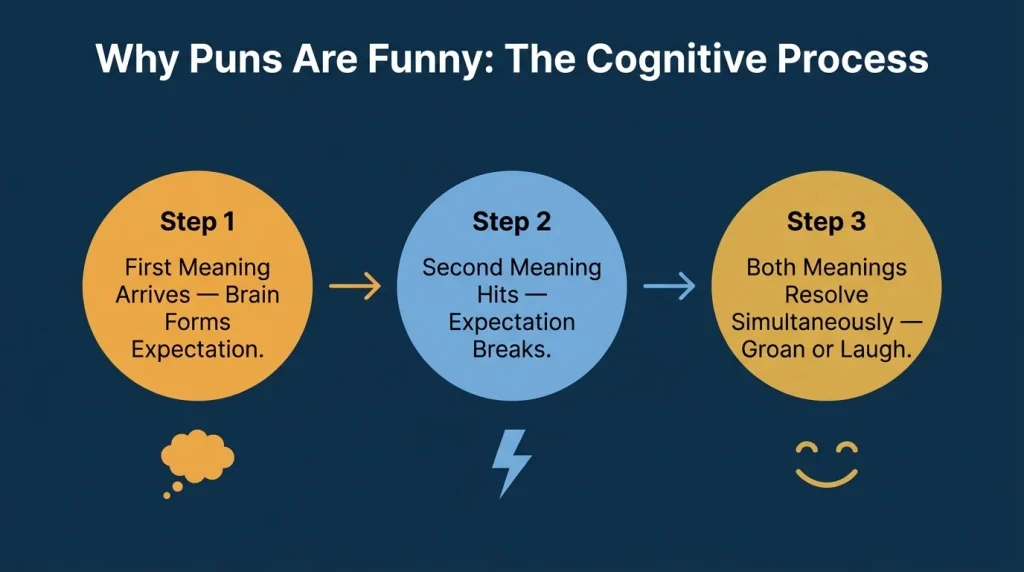
The cognitive process works like this:
Step 1: You hear the first meaning. Your brain forms an expectation.
Step 2: The punchline arrives with a second meaning. Your expectation breaks.
Step 3: Your brain resolves the two meanings simultaneously. That resolution produces either laughter, a groan, or that specific “oh no” expression that pun-makers everywhere live for.
The better the pun, the faster the cognitive collision happens. The best puns land almost before you’ve finished reading them.
“No Pun Intended” — What That Actually Means
This phrase comes up constantly. It’s worth understanding properly.
“No pun intended” is a common expression used to highlight a pun while ostensibly claiming that the pun was unintentional. This phrase is often used humorously to call attention to a pun that the speaker recognizes is cliché and likely to elicit a groan. However, in some cases the phrase is used sincerely, indicating that the speaker did not notice the pun until after it was spoken.
There’s a useful distinction there. “No pun intended” has two modes:
Ironic mode
The speaker absolutely intended the pun. They’re pointing it out to make sure you caught it.
Sincere mode
The speaker genuinely said something that happened to be a pun, noticed it mid-sentence, and wants credit for acknowledging it.
Both versions produce laughter. The ironic one more reliably so.
“Pun intended” works the opposite way — it’s the speaker proudly owning the joke rather than performing modesty about it.
Puns in Literature: From Shakespeare to Lewis Carroll
Puns have a long history in serious writing. This isn’t a modern internet phenomenon.
Examples of puns can be traced as far back as 184 B.C., with the plays of Roman playwright Plautus.
Shakespeare used them constantly. In Romeo and Juliet, Shakespeare plays on the meaning of the word “heavy” as both a descriptor for weight and sadness. Romeo says: “Give me a torch: I am not for this ambling; Being but heavy I will bear the light.”
That pun works on two levels: Romeo is literally carrying a torch (hence bearing a light) and he is emotionally heavy (sad about Rosaline). Two meanings. One sentence. Shakespeare did this throughout his career.
Oscar Wilde’s The Importance of Being Earnest has its biggest pun in the title. “Earnest” is a play on the name “Ernst.” The character Jack, who is neither earnest in nature nor Ernst by name, ends up being both by the novel’s end.
Lewis Carroll’s Alice’s Adventures in Wonderland is filled with puns to help illustrate the abnormality of Wonderland.
The lesson from literary puns is clear: a well-placed pun in serious writing adds depth rather than cheapening it. It creates layers of meaning that reward careful readers. It’s only when puns are forced or low-quality that they feel like a step down.
Puns in Advertising and Headlines
Editors and advertisers love a good pun. It gets the readers’ attention because they must read it once more to really get the meaning.
That’s the mechanism in commercial terms. A pun makes someone read twice. The second read is where the brand or message lodges in memory. That’s enormously valuable in advertising, where attention is the scarcest resource.
Classic examples from advertising include:
Headline puns work the same way. They compress multiple meanings into a small space and reward the reader who catches both.
Pun vs Dad Joke vs Play on Words
These terms get confused. Here’s the difference.
A Pun is specifically wordplay built on double meaning or similar sounds. It’s a precise linguistic device. All puns are wordplay. Not all wordplay is a pun.
A Dad Joke is a broad category of humor characterized by being deliberately simplistic, mildly corny, and told by someone who finds it funnier than their audience does. Many dad jokes are puns, but a dad joke can also just be an obvious or painfully predictable joke with no wordplay at all.
A Play on Words is the broadest term. It covers puns, double entendres, spoonerisms, malapropisms, and any other form of language manipulation for comedic or rhetorical effect. A pun is one specific type of play on words.
Double Entendre is a close relative but different in intent. In English, double entendre refers to a double meaning in which one meaning is usually shocking or risqué in its sexual suggestiveness. A pun usually has more to do with silly or humorous double meanings than with anything sexually suggestive.
So: all puns are wordplay, but not all wordplay is a pun. And most dad jokes contain puns but a dad joke can exist without one.
Good Puns vs Bad Puns: Is There a Real Difference?
People constantly argue about this. Here’s what’s actually true.
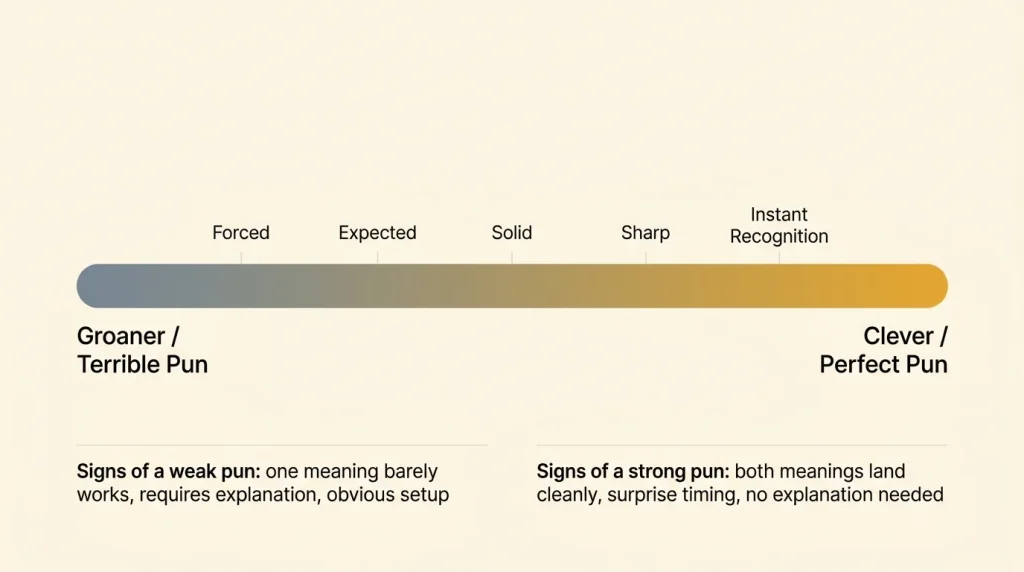
The pun community has a concept sometimes called the groan-laugh spectrum. On one end, a pun makes you laugh immediately — the double meaning is clever and surprising. On the other end, a pun makes you groan — the double meaning is obvious and the wordplay feels forced.
But here’s the counterintuitive thing: the groan is not a sign of failure. A groaner pun is still doing its job. The groan is the audience’s way of acknowledging the pun, participating in the moment, and signaling that they caught the joke. A pun that produces nothing — no laugh, no groan, no recognition — is the only truly failed pun.
Qualities of a Strong Pun
Qualities of a Weak Pun
The “terrible” puns and “bad puns” people search for? Those are usually deliberately awful — puns constructed to be as groan-worthy as possible, which is its own valid category of humor.
Double Meaning Puns: The Most Satisfying Kind
Double meaning puns are the core of the form. They use a single word that carries two complete, coherent meanings simultaneously.
The most satisfying examples are the ones where both meanings work perfectly in context:
“I’m reading a book about anti-gravity. It’s impossible to put down.”
“Put down” means both stopping reading and the literal act of placing the book on a surface. Both meanings are completely natural. Neither is a stretch. That’s double meaning pun perfection.
“The bicycle couldn’t stand on its own because it was two-tired.”
“Two-tired” means both having two tires and being too tired to stand. One word. Both meanings land cleanly.
Puns by Category: Browse the Full Collection
The best puns are topic-specific — they use the particular vocabulary of a subject and find the double meanings hiding inside it. Here are the most popular categories, each with its own dedicated collection on this site.
Food & Drink Puns
If your subject matter is food, you’ve got an enormous vocabulary to work with. Our cheese puns collection covers over 145 original lines using cheddar, brie, gouda, and more — each cheese type with its own wordplay. For morning content, the coffee puns collection includes over 165 lines built around espresso, brewing, grinding, and café culture. And if you’re working with something as versatile as bread puns, there’s an entire Taylor Swift bread puns section in there that has no right to exist but absolutely does.
Special Occasion Puns
Birthday puns organized by milestone age (30th and 40th), pet theme (cat, dog, dinosaur, fish, shark), and food theme (donut, coffee) give you a pun for every possible birthday card situation. And egg puns cover Easter, birthdays, and the surprisingly rich category of one-word egg puns for hashtags and stickers.
Every category works the same way at its core — it finds the specific vocabulary of a subject, identifies the double meanings hiding inside those words, and builds humor from the collision between what words mean in their natural context and what they mean when you twist them slightly sideways.
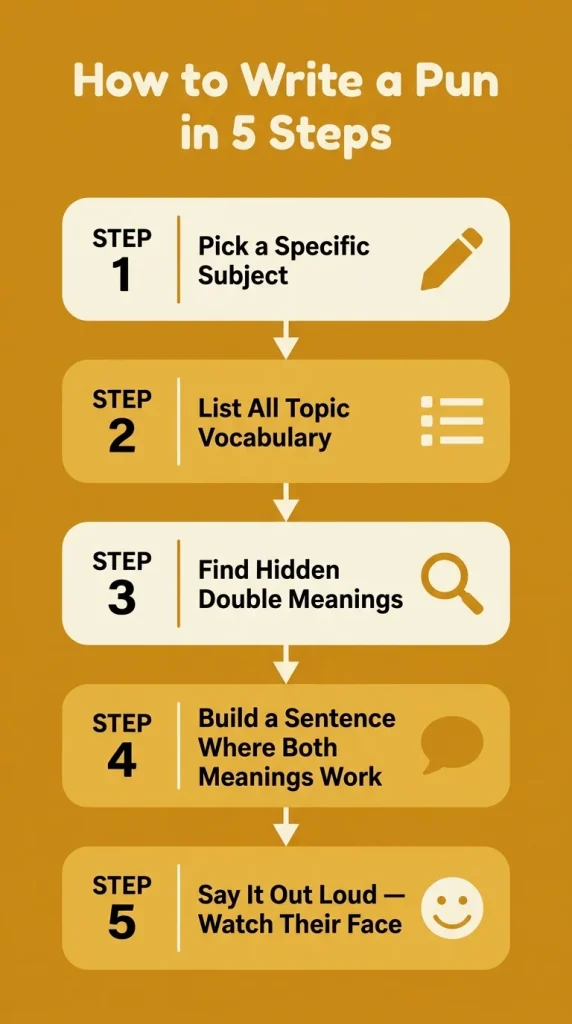
How to Write a Pun From Scratch
Anyone can write a pun. Here’s the exact process.
The golden rule: Both meanings must work in context. If you have to explain which meaning is the pun, the pun didn’t land — rewrite it.
Puns in Different Languages: Does the Meaning Change?
Puns may be regarded as in-jokes or idiomatic constructions, especially as their usage and meaning are usually specific to a particular language or its culture.
This is why puns are notoriously difficult to translate. A pun in English relies on the specific sounds and multiple meanings of English words. Those rarely map directly onto another language.
A classic example: the phrase “the pen is mightier than the sword” becomes a pun opportunity in English because “pen” can refer to writing or to a livestock enclosure. In French, that double meaning doesn’t exist in the same form.
This language-specificity is actually part of what makes puns interesting from a linguistic standpoint — they reveal the specific quirks, accidents, and evolutionary accidents of a particular language more clearly than almost any other form of expression.
The Psychology of the Groan: Why People Love to Hate Puns
The groan is the pun’s most distinctive response. No other form of humor consistently produces that specific sound.
Research suggests the groan serves a social function. It’s a signal that says: “I understood what you did there, I acknowledge your attempt, but I’m performing disappointment at how obvious it was.” The groan is simultaneously a form of participation and gentle mockery.
Interestingly, people who claim to hate puns often laugh most at the best ones. The protest is performative. The enjoyment is genuine. This is the pun’s unique position in humor culture — it produces the loudest complaints and the most reliable smiles in the same moment.
Studies in humor psychology suggest that pun appreciation correlates with higher verbal intelligence and stronger creative thinking. People who genuinely enjoy puns tend to score higher on tests of linguistic flexibility — the ability to hold multiple meanings of a word in mind simultaneously.
So if someone tells you puns are the lowest form of humor: they’re wrong, and they’re probably not enjoying themselves.
Famous Puns That Changed How We Think About Language
Some puns became so well-known they embedded themselves permanently in cultural vocabulary.
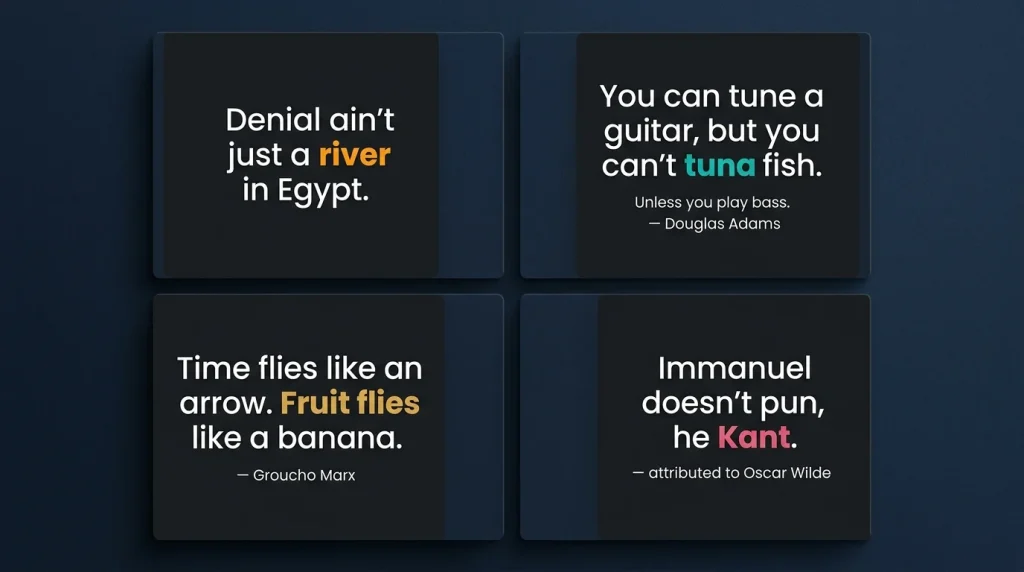
“Denial ain’t just a river in Egypt.” — This works on “Denial” / “da Nile” (the river Nile). It’s become a therapeutic cliché, which means the pun has outlived its joke function and become genuinely instructive.
“Make like a tree and leave.” — “Leave” means both to depart and a tree’s leaf. Simple, perfect, endlessly repeated.
“You can tune a guitar, but you can’t tuna fish. Unless of course, you play bass.” — Douglas Adams. This quote contains a homophonic pun on “tune a” and “tuna,” as well as a homographic pun on “bass” — the guitar instrument pronounced “base” and the fish pronounced “bass.”
Oscar Wilde’s recursive pun: “Immanuel doesn’t pun, he Kant” — attributed to Oscar Wilde. This recursive pun requires knowledge of the philosopher Immanuel Kant to understand why “Kant” sounds like “can’t.”
Each of these demonstrates a different dimension of pun mastery: cultural embedding, simplicity, layered complexity, and recursive referencing respectively.
Frequently Asked Questions
Related Content You’ll Find on This Site
Every article linked below uses the exact principles explained here — finding the specific vocabulary of a subject, identifying the double meanings hiding inside those words, and building humor from the collision of those meanings.
-
Eno Meaning: 9 Facts, Fruit Salt, Brian Eno & Opera Explained (2026)
Depending on where you’re reading this from, “Eno” might immediately bring to mind a fizzy glass of antacid after a…
-
Neti Meaning: 9 Facts, Neti Pot vs Neti Neti Explained 2026
Search “neti meaning” and you might be trying to figure out what that little teapot-shaped device in the pharmacy aisle…
-
Abut Meaning: 9 Facts, Legal Use & Word Origins 2026
A real estate listing boasts that the backyard “abuts a nature preserve,” and it’s clear enough what that means in…
-
Myrrh Meaning: 10 Facts, Biblical Symbolism & Modern Uses 2026
Every Christmas, the Nativity story mentions three gifts brought to the infant Jesus — gold, frankincense, and myrrh — and…
-
Grifter Meaning: 9 Facts, Origins & Modern Usage 2026
Open almost any news story about a collapsed crypto scheme, a wellness influencer selling miracle cures, or a political scandal,…
-
Rizz Meaning: 10 Facts, Origins & Oxford’s Word of the Year 2026
A word that started among a small group of friends from the Bronx ended up beating out “Swiftie” and “situationship”…