
Finlet Meaning: 7 Facts, Function & the Tuna Speed Myth 2026
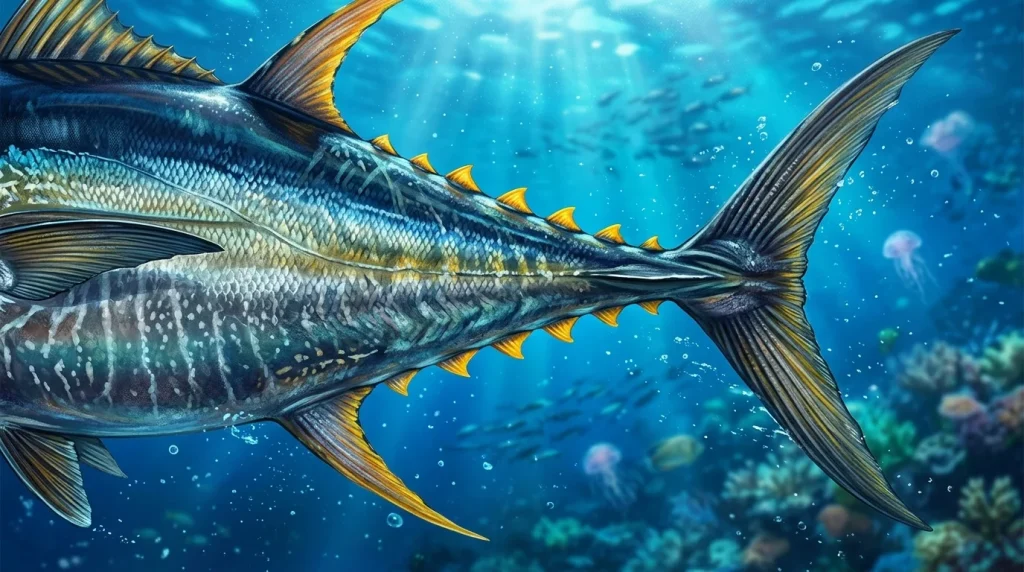
Watch a tuna or mackerel swim and you’ll notice a row of tiny fins trailing between its main dorsal fin and its tail — too small to look like they’re doing much of anything. That assumption turns out to be only half right.

This guide covers what a finlet actually is, which fish have them, and what real hydrodynamics research has found about their function, which is more interesting than the “they reduce drag” explanation you’ll see repeated almost everywhere.
See Also: Linklater Meaning
Quick Answer
Finlet means a small, isolated fin — typically one of a series of small fins positioned between the main dorsal or anal fin and the tail fin in certain fast-swimming fish, most notably mackerels, tunas, and bonitos.

What Finlet Means
At its simplest, a finlet is a little fin — literally “fin” plus the diminutive suffix “-let,” the same pattern found in words like “booklet” or “piglet.” Merriam-Webster defines it broadly as one of the parts of a divided fin, but in practice,
the word is almost always used in a specific ichthyological (fish biology) sense: the small, non-retractable fins arranged in a row along the back and belly of certain fish, positioned between the primary dorsal or anal fin and the caudal (tail) fin.
Finlets are found specifically in members of the Scombridae family — mackerels, tunas, and bonitos — as well as a few related groups like sauries. They’re a defining anatomical feature used to help identify and classify these fast-swimming, streamlined fish.
Finlets Aren’t All Built the Same Way
Here’s a precise anatomical distinction most short definitions skip entirely: finlets aren’t structurally identical across every species that has them. According to zoological reference sources, a finlet can be formed in two different ways — either as a separate spine with its own membrane,
as seen in the stickleback, or as a membrane alone with no supporting spine at all, as is the case in tuna. Despite sharing the same name and general position on the body, these are meaningfully different structures depending on the species.
The Popular “Finlets Reduce Drag” Explanation — And Why It’s Oversimplified
You’ll find this claim repeated across many casual explainer sites: finlets exist to reduce water resistance, helping fast-swimming fish like tuna swim more efficiently. It’s a tidy explanation, but actual peer-reviewed hydrodynamics research complicates it in a genuinely interesting way.
A computational and experimental study of yellowfin tuna, conducted by researchers including those affiliated with Harvard’s Museum of Comparative Zoology and published via PubMed, found that finlets are actually drag-producing on their own — not drag-reducing, as the popular explanation suggests.
However, the finlets don’t function in isolation: their coordinated pitching and heaving motion, moving in a delayed sequence from front to back along the body, reduces the total drag the finlets themselves generate by roughly 20%, compared to finlets that don’t pitch at all.
The researchers also found evidence that this pitching motion may help support the efficiency of the tail’s propulsive flapping motion, through complex interactions in the surrounding water flow.
In short: finlets aren’t a simple drag-cutting device bolted onto the fish’s body. They’re small, actively drag-producing structures whose own motion partially offsets that drag while potentially assisting the tail’s performance — a more nuanced picture than “finlets make fish faster.”

Finlet Coloring and Visibility
Finlets in many Scombrid species are often brightly colored or distinctly marked compared to the rest of the body, making them a useful visual feature for quickly identifying species in the water or when examining a catch.
This coloring is thought to play a role in visual signaling, though finlets themselves remain a relatively small area of ongoing research compared to other aspects of these fish’s anatomy.
FAQ
What does finlet mean in simple terms? A small, isolated fin — most often referring to one of a row of small fins found between the main dorsal or anal fin and the tail in fish like tuna and mackerel.
Do all fish have finlets? No — finlets are specific to certain fish families, most notably Scombridae (mackerels, tunas, bonitos), along with a few related groups like sauries.
Do finlets actually make fish swim faster by reducing drag? It’s more complicated than that popular explanation suggests. Peer-reviewed research on tuna found finlets are individually drag-producing, though their coordinated motion reduces their own drag and may assist the tail’s swimming efficiency.
What’s the difference between a finlet and a regular fin? Finlets are notably smaller, non-retractable, and typically appear in a series rather than as a single structure, positioned specifically between a main fin and the tail — unlike primary fins, which are larger, singular structures used more directly for propulsion or steering.
Are finlets built the same way in every fish species? No — some species (like the stickleback) have finlets formed from a spine with its own membrane, while others (like tuna) have finlets made purely of membrane, without any supporting spine.
Why are finlets often brightly colored? It’s thought to aid in visual species identification and possibly social or mating-related signaling, though this remains an area of ongoing biological study.